For the first hour
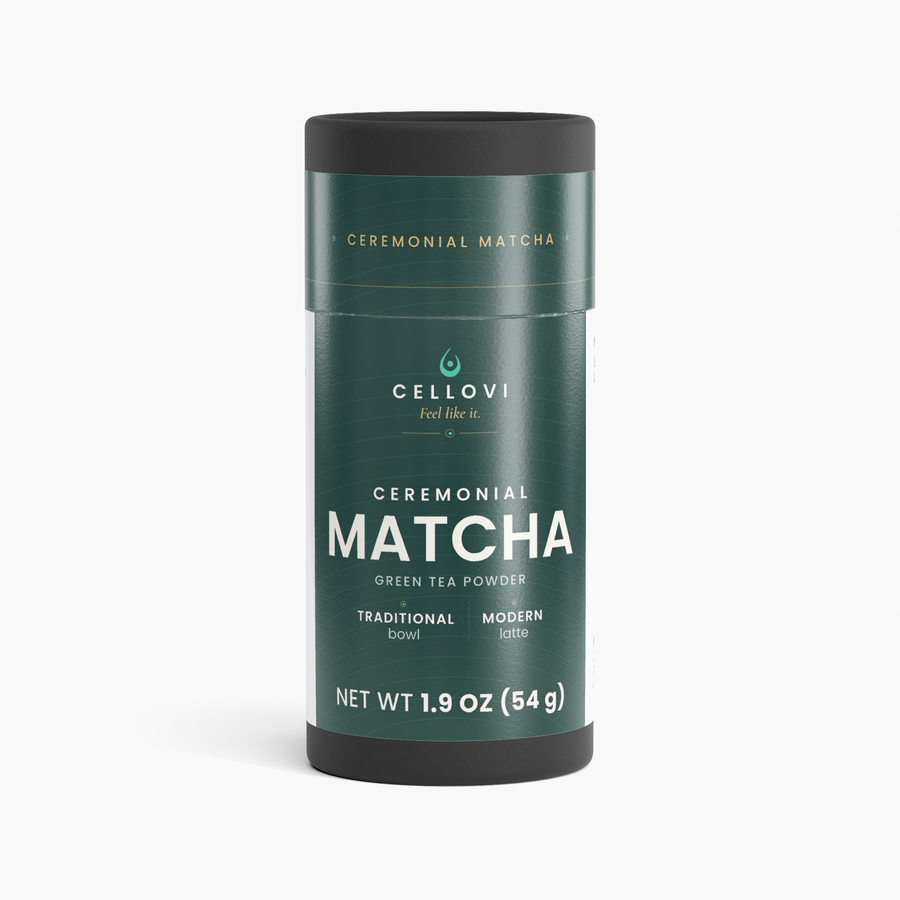
Ceremonial Matcha
Shade-grown in Kyoto, Japan · 54 g tin · about 25 to 30 cups
- Third-party lab tested
- Vegan
- Gluten-free
- Non-GMO
- Lactose-free
+6 moreShow less
- Halal
- Corn-free
- All natural
- Cruelty-free
- Hormone-free
- Antibiotic-free
Goal: Strength & focus
Your daily ritual, whisked. Cellovi Ceremonial Matcha is shade-grown green tea from Kyoto, Japan, stone-ground into a fine, vibrant powder. Whisk one teaspoon with hot water for a traditional bowl, or whisk it with a splash of hot water and top with milk for a latte. Each 54 g tin makes about 25 to 30 cups.
Two ways to drink it
- Traditional bowl
- Modern latte

Your ritual
For the first hour
- Sift one teaspoon into a warm bowl.
- Add hot water and whisk in a quick zigzag until it froths.
- Hold the bowl in both hands and drink it slowly.
The first hour, whisked.
The moment is when you whisk it.
You know your days best. We bring the matcha.
What is inside
- Ceremonial matcha from Kyoto, Japan, made for whisking and drinking straight
- Shade-grown, stone-ground Camellia sinensis leaves
- One ingredient: matcha green tea powder
- Third-party lab tested
- 54 g (1.9 oz) tin, about 25 to 30 cups at 1 teaspoon each
- Natural caffeine with L-theanine
- About $1.80 a cup
Matcha is the whole tea leaf, ground, so you drink the leaf itself rather than water it was steeped in. That is why it tastes richer and smoother than steeped green tea, with a naturally sweet, umami finish. Like all tea, it naturally contains caffeine and L-theanine, an amino acid found in tea leaves.
Where it sits in your day
Morning
Ceremonial Matcha
Traditional: sift 1 teaspoon into a bowl. Add 2 to 3 oz (60 to 90 mL) of water at 160 to 175°F (70 to 80°C), then whisk briskly in a zigzag until frothy.
Latte: whisk 1 teaspoon with a splash of hot water, then top with 6 to 8 oz (177 to 237 mL) of steamed or iced milk.
Who it is for
Coffee drinkers who want a new morning ritual, tea lovers ready for the real thing, and anyone who wants café-style matcha lattes at home.
Before you start
Interactions and cautions
Ask your pharmacist or doctor first if you take:
- prescription medicines: green tea can lower blood levels of some, such as the blood-pressure drug nadolol.
Check with your doctor first if you:
- are pregnant or nursing: the usual advice is under 200 mg of caffeine a day, and a teaspoon of matcha has about 40 to 90 mg
Sensitive to caffeine? Start with half a teaspoon. Watching your iron? Tea can reduce iron absorption from a meal, so enjoy matcha between meals.
Not a complete list. Show your pharmacist everything you take, including other supplements. Sources: Misaka et al., 2014; ACOG, caffeine in pregnancy; Temme and Van Hoydonck, 2002.
Label warnings and storage
Naturally contains caffeine. If you are pregnant or nursing, check with your doctor first. If you are sensitive to caffeine, start with half a teaspoon. Once opened, keep the tin tightly closed in a cool, dark, dry place, and enjoy it within about a month for the brightest color and flavor.
Made in a facility that also handles tree nuts, sesame, celery and mustard. Keep out of reach of children. Do not use if the seal is broken when the tin arrives.
Report a reaction: safety@cellovi.com
- From Kyoto, JapanShade-grown, stone-ground
- Nothing addedPure ceremonial matcha, lab tested
- Free US shippingOn $50 or more
What you get, and what you don’t
Most matcha labels skip the details. Here are ours, in large print.
| What matters | Cellovi Ceremonial Matcha | Many matcha powders |
|---|---|---|
| The tin | Cellovi Ceremonial Matcha: Pure ceremonial matcha, nothing added | Many matcha powders: Culinary grade, sugar or fillers |
| The timing | Cellovi Ceremonial Matcha: A time of day, built into a routine | Many matcha powders: "Take daily", and you work out the rest |
| The making | Cellovi Ceremonial Matcha: Shade-grown and stone-ground in Kyoto, Japan | Many matcha powders: Facility and standard often unstated |
| The buying | Cellovi Ceremonial Matcha: One-time purchase: reorder when you run low | Many matcha powders: Auto-ship you have to call to stop |
Reviews
New, so no reviews yet
Here is what you can check instead: where it is grown, how it is made and what is in the tin, all on this page. We won’t fill this space with borrowed praise.
We started Cellovi because shopping for supplements meant wading through big promises, hidden doses and claims with no study in sight. So we built the brand we wanted to buy from.
One ingredient, shade-grown and stone-ground in Kyoto, and third-party lab tested. And your first order comes with our 60-day first-order guarantee. How it works
Your reviews come next, and we’ll read every one.
Be among the first to review
We ask every buyer once, after delivery. Only verified buyers post, every rating shows from one star to five, our team and families never review, and nothing is offered in return.
Questions, answered
It describes matcha made from young, shade-grown leaves, stone-ground fine enough to whisk with water alone. Ceremonial matcha is meant to be enjoyed on its own or in a latte; culinary matcha is made for baking and cooking. There is no official standard, so origin, color and taste are what to judge.
A teaspoon (about 2 g) of matcha usually contains about 40 to 90 mg of caffeine, depending on the leaf and how much you use. For comparison, an 8 oz cup of brewed coffee has about 75 to 165 mg.
160 to 175°F (70 to 80°C). Boiling water scorches matcha and makes it bitter; let a just-boiled kettle rest for about 2 minutes.
A bamboo whisk (chasen) gives the finest froth, but a handheld milk frother or a shaker bottle works well too.
Yes. The only ingredient is matcha green tea powder.
Feel like it.