Last reviewed October 26, 2026 by the Cellovi team.
The short answer
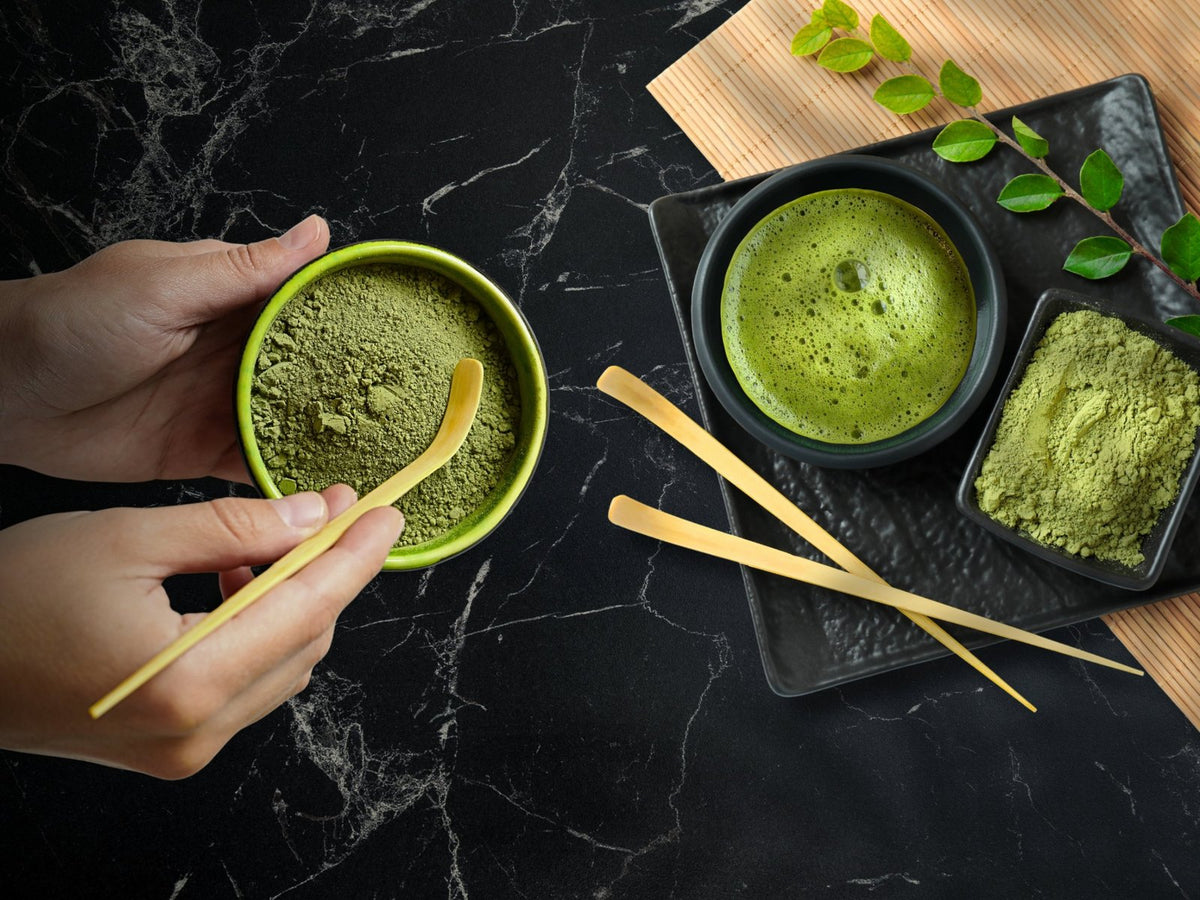
Matcha is green tea grown in the shade, then stone-ground into a fine powder. Because you whisk the powder into water, you drink the whole leaf, not only what steeps out of it. A level teaspoon (about 2 g) of good Japanese matcha usually has about 40 to 90 mg of caffeine. It also has L-theanine, an amino acid that tea plants make more of in the shade. That pairing is why many people describe matcha’s lift as calmer and steadier than coffee’s. “Ceremonial” describes matcha made to be whisked and enjoyed on its own.
How we rate it: matcha is a food, so we don’t grade the tea itself. Research on caffeine with L-theanine for focused alertness is encouraging: several short trials point the same way.
What makes matcha different
- Shade. For about three weeks before harvest, the tea plants are covered. Less sunlight raises L-theanine, the source of matcha’s sweet, savory umami taste, and lowers the compounds that make tea astringent (Unno et al., 2018; Ku et al., 2010).
- Leaf, not stems. The shaded leaves are steamed, dried, and stripped of stems and veins. The result, called tencha, is then stone-ground into matcha.
- Whole leaf. With steeped tea, the leaves stay in the pot. With matcha, everything in the leaf is in your cup.
What “ceremonial” means
There is no official ceremonial or culinary grade. Ippodo, a long-established Kyoto tea house, notes that “ceremonial grade” was created to describe matcha for overseas buyers and isn’t used in Japan (Ippodo). In practice, ceremonial-style matcha is made from young, shaded leaves, ground fine enough to whisk with water alone, and tastes smooth rather than bitter. Culinary matcha is made for baking and cooking.
Lab tests back up the difference in quality. In one study, most matcha sold in Japan was rich in L-theanine, while most matcha sold overseas was not (Unno et al., 2018). So judge matcha by origin, color and taste: a vivid green, a fresh grassy smell and a sweet finish are good signs.
What’s in a cup
| Per serving | Caffeine |
|---|---|
| Matcha, 1 level teaspoon (about 2 g) | About 40 to 90 mg |
| Brewed coffee, 8 oz | About 75 to 165 mg |
| Brewed green tea, 8 oz | About 25 mg |
Sources: Meyer et al., 2023; Unno et al., 2018; coffee and green tea from the US Food and Drug Administration (FDA), scaled from 12 oz.

A level teaspoon of good matcha also gives you roughly 35 to 90 mg of L-theanine and the tea’s natural catechins, plant compounds that include EGCG (epigallocatechin gallate). A heaping teaspoon gives you more of everything, caffeine included.
Caffeine plus L-theanine
Several short lab studies tested caffeine and L-theanine together, at amounts close to a cup of matcha:
- 50 mg of caffeine with 100 mg of L-theanine improved the speed and accuracy of switching attention between tasks (Owen et al., 2008).
- 40 mg of caffeine with 97 mg of L-theanine improved task accuracy and alertness compared with placebo (Giesbrecht et al., 2010).
- A matcha drink itself improved attention an hour later (Dietz et al., 2017).
- Students drinking 3 g of matcha a day, rich in L-theanine, for 15 days felt less anxious before a stressful period and had a lower salivary stress marker than a low-theanine group (Unno et al., 2018).
It is the gentle lift you’d expect from a cup of tea: enjoy it for the ritual and the taste.
About “137 times the antioxidants”
You may have read that matcha has 137 times the antioxidants of green tea. That number comes from a 2003 lab study that compared matcha’s EGCG with one low-quality tea, not with green tea in general. Compared with published values for other green teas, matcha had at least three times more EGCG (Weiss and Anderton, 2003).
How to make it
- Traditional bowl: sift 1 level teaspoon into a bowl, add 2 to 3 oz of water at 160 to 175°F, and whisk briskly in a zigzag until frothy, about 15 seconds. Water that’s too hot makes it bitter.
- Latte: whisk the same teaspoon with a splash of hot water, then top with 6 to 8 oz of steamed or iced milk. Add a scoop of collagen if you like.
- Storage: once opened, keep the tin tightly closed in a cool, dark, dry place. Light and humidity dull matcha’s color and its natural compounds over a few weeks (Kim et al., 2026), so enjoy it while it’s vivid green.
Good to know
- Caffeine limits. The FDA considers up to 400 mg a day generally fine for healthy adults (FDA). During pregnancy, the usual advice is under 200 mg a day (American College of Obstetricians and Gynecologists), so talk to your doctor. For sleep, enjoy matcha in the morning or early afternoon.
- Green tea as a drink is considered safe. Concerns about EGCG relate to concentrated green tea extracts in pills, at amounts far above a few cups of tea (European Food Safety Authority, 2018; National Center for Complementary and Integrative Health).
- Iron. Tea can reduce iron absorption from a meal. If you watch your iron, enjoy matcha between meals (Temme and Van Hoydonck, 2002).
- Medicines. Green tea can lower blood levels of some medicines, such as the blood-pressure drug nadolol (Misaka et al., 2014). If you take prescription medicines, ask your pharmacist.
Where it fits in your day
Cellovi Ceremonial Matcha is shade-grown, stone-ground green tea from Kyoto, Japan: one ingredient, third-party lab tested, about 25 to 30 cups per tin. Pair it with Collagen Peptides for a morning latte, or read Your day, built for where caffeine fits best.
Common questions
How much caffeine is in matcha compared with coffee?
A level teaspoon (about 2 g) of good matcha usually has about 40 to 90 mg, compared with about 75 to 165 mg in an 8 oz cup of brewed coffee. A heaping teaspoon gives you more.
Why does matcha feel calmer than coffee?
Matcha also contains L-theanine, an amino acid that tea plants make more of in the shade. This article’s section on caffeine and L-theanine covers what the short studies found.
What does ceremonial grade mean?
There is no official grade. In practice it means matcha from young, shaded leaves, ground fine enough to whisk with water alone, with a smooth rather than bitter taste.
When is the best time to drink matcha?
Morning or early afternoon, so the caffeine stays clear of your sleep. If you watch your iron, enjoy it between meals.
Sources
- Unno K et al. Stress-reducing function of matcha green tea in animal experiments and clinical trials. Nutrients, 2018.
- Ku KM et al. Metabolomics analysis reveals the compositional differences of shade grown tea (Camellia sinensis L.). Journal of Agricultural and Food Chemistry, 2010.
- Ippodo Tea. Is Ippodo matcha ceremonial grade?
- Meyer BR et al. Catechin composition, phenolic content, and antioxidant properties of commercially-available bagged, gunpowder, and matcha green teas. Plant Foods for Human Nutrition, 2023.
- US Food and Drug Administration. Spilling the beans: how much caffeine is too much?
- Owen GN et al. The combined effects of L-theanine and caffeine on cognitive performance and mood. Nutritional Neuroscience, 2008.
- Giesbrecht T et al. The combination of L-theanine and caffeine improves cognitive performance and increases subjective alertness. Nutritional Neuroscience, 2010.
- Dietz C, Dekker M, Piqueras-Fiszman B. An intervention study on the effect of matcha tea, in drink and snack bar formats, on mood and cognitive performance. Food Research International, 2017.
- Weiss DJ, Anderton CR. Determination of catechins in matcha green tea by micellar electrokinetic chromatography. Journal of Chromatography A, 2003.
- Kim JM et al. Effect of water activity and light exposure on the stability of bioactive compounds in matcha (Camellia sinensis) powder during storage periods. Food Chemistry, 2026.
- American College of Obstetricians and Gynecologists. Moderate caffeine consumption during pregnancy, Committee Opinion 462.
- EFSA Panel on Food Additives and Nutrient Sources added to Food. Scientific opinion on the safety of green tea catechins. EFSA Journal, 2018.
- National Center for Complementary and Integrative Health. Green tea.
- Temme EH, Van Hoydonck PG. Tea consumption and iron status. European Journal of Clinical Nutrition, 2002.
- Misaka S et al. Green tea ingestion greatly reduces plasma concentrations of nadolol in healthy subjects. Clinical Pharmacology and Therapeutics, 2014.