Last reviewed October 28, 2026 by the Cellovi team.
The short answer
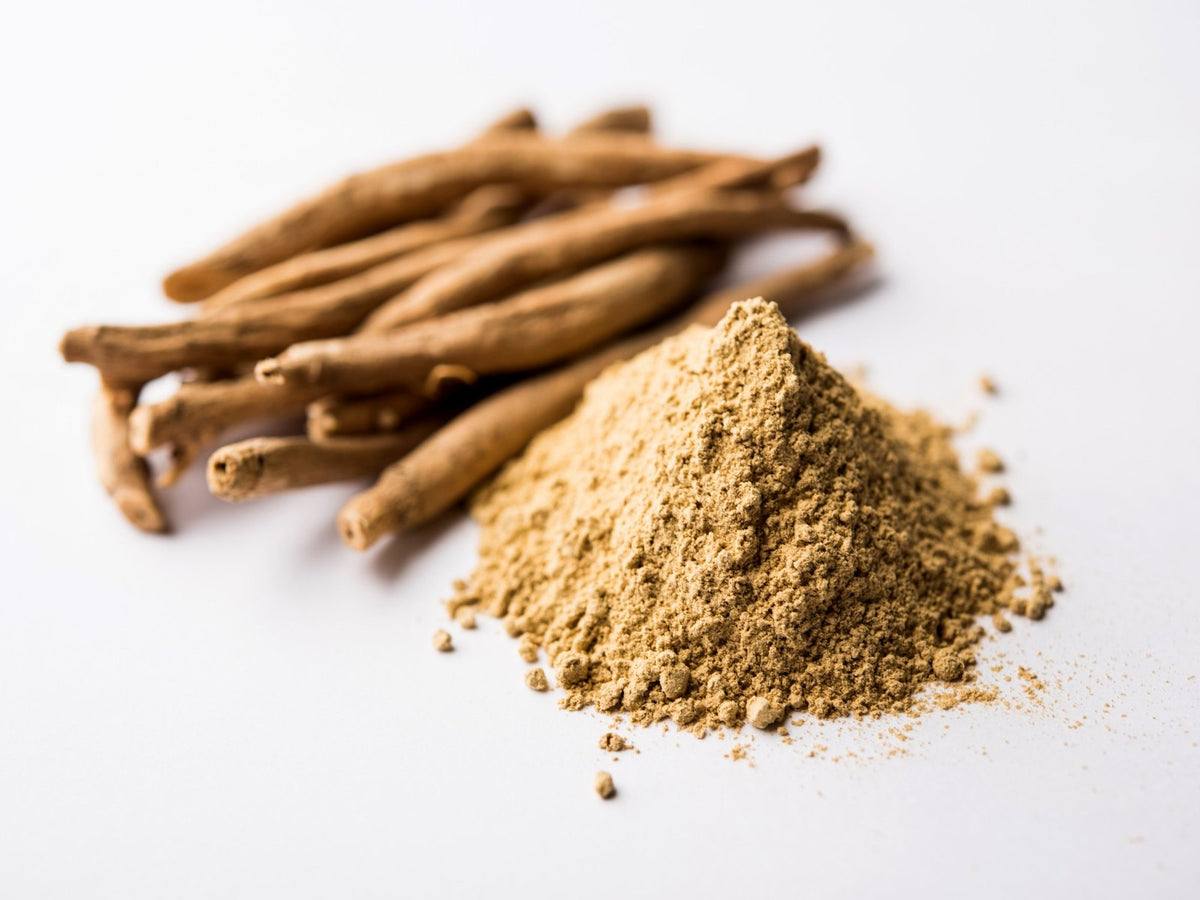
Ashwagandha is a root used for centuries in Ayurvedic tradition, and KSM-66 is the extract behind most of its sleep trials. In three placebo-controlled trials of adults under everyday stress, 600 mg of KSM-66 a day for about 8 weeks lowered scores on a standard stress questionnaire more than placebo. A stress hormone, cortisol, fell more than with placebo too. The trials agree with each other, and we grade it Growing. It is a daily routine measured in weeks; check the safety notes below before you start.*
Our grade: Growing. The studies point the same way, especially for stress-hormone levels. We review the grade as new trials are published.
What KSM-66 is
KSM-66 is a full-spectrum extract made from ashwagandha root only and standardized to 5% withanolides, the plant’s signature compounds. Most KSM-66 trials used 600 mg a day, usually split into two 300 mg doses, which is the amount in Cellovi Ashwagandha Plus. In the NIH Office of Dietary Supplements’ review of the research, KSM-66 was used in most of the sleep trials and several of the stress trials, with the clearest benefits at 500 to 600 mg a day (NIH ODS).
What the studies found
| Study | Who | Dose and length | What changed versus placebo |
|---|---|---|---|
| Chandrasekhar et al., 2012 | 64 adults with ongoing stress | 600 mg a day, 60 days | Perceived Stress Scale down 44% (placebo 5.5%); stress hormone (cortisol) down 28% (placebo 8%) |
| Salve et al., 2019 | 60 healthy adults under stress | 250 or 600 mg a day, 8 weeks | On 600 mg: stress scores down 38% (placebo 27%), stress hormone down 33% (placebo 4%), better sleep quality |
| Choudhary et al., 2017 | 52 adults under chronic work stress | 600 mg a day, 8 weeks | Stress scores lower than placebo at week 8; stress hormone (cortisol) fell more than with placebo |
| Choudhary et al., 2015 | 50 healthy athletic adults | 600 mg a day, 12 weeks | Larger gains in aerobic capacity (VO2 max, a measure of aerobic fitness) and quality-of-life scores |
| Kelgane et al., 2020 | 50 adults aged 65 to 80 | 600 mg a day, 12 weeks | Better sleep quality and mental alertness on waking, and higher quality-of-life scores |

Reviews that pool the trials point the same way:
- 12 trials with 1,002 people: lower stress scores at 300 to 600 mg a day (Akhgarjand et al., 2022).
- 9 trials with 558 people: lower perceived stress and lower stress-hormone levels (Arumugam et al., 2024).
- 5 trials in healthy men and women: more strength and power than placebo (Bonilla et al., 2021).
How long until you notice anything
Most trials measured at 4 and 8 weeks. In one trial, stress scores had already fallen more than with placebo by week 4, and in the 2019 trial above, the clear difference from placebo appeared by week 8. So we suggest taking it every morning for 6 to 8 weeks before you judge it. It supports your body's normal response to occasional stress over time; it is not a sedative, and its benefits build with daily use.*
Who should check with a doctor first
For most healthy adults, ashwagandha is well tolerated in studies of up to about 3 months (NIH Office of Dietary Supplements). Side effects, when they happen, are usually mild: stomach upset, loose stools or drowsiness.
Do not take it if you are pregnant or breastfeeding, or under 18.
Talk to your doctor first if you:
- have a thyroid condition or take thyroid medication: in one 8-week study, ashwagandha changed thyroid hormone levels (Sharma et al., 2018);
- have a liver condition or an autoimmune condition;
- take medicines for blood sugar, blood pressure, sleep or seizures, sedatives, or medicines that suppress the immune system (National Center for Complementary and Integrative Health);
- have surgery planned, or hormone-sensitive prostate cancer.
Stop and see a doctor if you notice yellowing of the skin or eyes, dark urine or unusual itching. Rare cases of liver injury have been reported, usually 2 to 12 weeks after starting, and they generally resolved after stopping (NIH LiverTox).
What else is in Ashwagandha Plus
The grade on this page is for KSM-66, the main ingredient, at its studied dose. Ashwagandha Plus adds Panax ginseng (100 mg), which has its own body of research on everyday fatigue (NCCIH). It also brings traditional maca (150 mg) and shatavari (50 mg), L-arginine (300 mg), and vitamins D3, B6 and B12 at everyday amounts.*
How to take it
- 2 capsules with breakfast, every day. Ginseng can be energizing, so morning is best.
- Pair it with Magnesium Glycinate in the evening: together they make our Calm & Sleep Protocol.
- Give it 6 to 8 weeks. If it is not for you, our first-order guarantee covers it.
See Ashwagandha Plus · also part of His Healthspan.
Common questions
How long does ashwagandha take to work?
Most trials measured at 4 and 8 weeks. In one, stress scores had already fallen more than with placebo by week 4, and in another the clear difference from placebo appeared by week 8. Take it every morning for 6 to 8 weeks before you judge it.*
Should I take ashwagandha in the morning or at night?
Ashwagandha Plus goes with breakfast, because the Panax ginseng in it can be energizing. Pair it with Magnesium Glycinate in the evening for our Calm & Sleep Protocol.
Is ashwagandha safe if I have a thyroid condition?
Talk to your doctor first. In one 8-week study, ashwagandha changed thyroid hormone levels, so it matters if you have a thyroid condition or take thyroid medication.
What is KSM-66?
A full-spectrum extract made from ashwagandha root only and standardized to 5% withanolides. It is the extract used in most of the sleep trials and several of the stress trials, usually at 600 mg a day, the amount in Ashwagandha Plus.
Sources
- Chandrasekhar K, Kapoor J, Anishetty S. A prospective, randomized double-blind, placebo-controlled study of safety and efficacy of a high-concentration full-spectrum extract of ashwagandha root in reducing stress and anxiety in adults. Indian Journal of Psychological Medicine, 2012.
- Salve J et al. Adaptogenic and anxiolytic effects of ashwagandha root extract in healthy adults: a double-blind, randomized, placebo-controlled clinical study. Cureus, 2019.
- Choudhary D, Bhattacharyya S, Joshi K. Body weight management in adults under chronic stress through treatment with ashwagandha root extract: a double-blind, randomized, placebo-controlled trial. Journal of Evidence-Based Complementary & Alternative Medicine, 2017.
- Choudhary B, Shetty A, Langade DG. Efficacy of ashwagandha in improving cardiorespiratory endurance in healthy athletic adults. Ayu, 2015.
- Kelgane SB et al. Efficacy and tolerability of ashwagandha root extract in the elderly for improvement of general well-being and sleep: a prospective, randomized, double-blind, placebo-controlled study. Cureus, 2020.
- Akhgarjand C et al. Does ashwagandha supplementation have a beneficial effect on the management of anxiety and stress? A systematic review and meta-analysis. Phytotherapy Research, 2022.
- Arumugam V et al. Systematic review and meta-analysis of randomized trials. Explore (NY), 2024;20(6):103062.
- Bonilla DA et al. Effects of ashwagandha (Withania somnifera) on physical performance: systematic review and Bayesian meta-analysis. Journal of Functional Morphology and Kinesiology, 2021.
- Sharma AK, Basu I, Singh S. Efficacy and safety of ashwagandha root extract in subclinical hypothyroid patients. Journal of Alternative and Complementary Medicine, 2018.
- NIH Office of Dietary Supplements. Ashwagandha: fact sheet for health professionals, 2025.
- National Center for Complementary and Integrative Health. Ashwagandha; Asian ginseng.
- NIH LiverTox. Ashwagandha, updated 2024.
*These statements have not been evaluated by the Food and Drug Administration. This product is not intended to diagnose, treat, cure, or prevent any disease.